
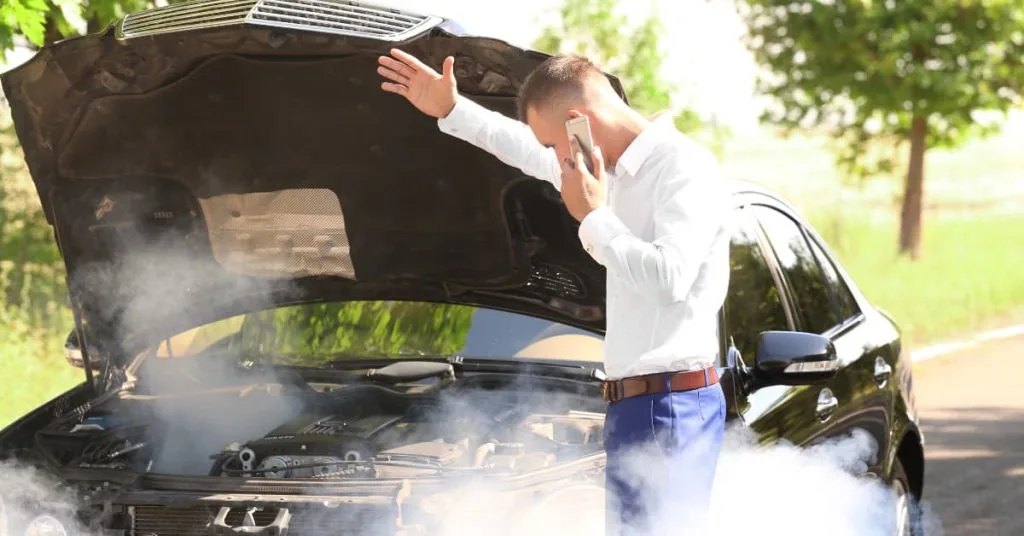
Your temperature gauge just spiked. Steam is curling out from under the hood. Maryland summer heat is baking the asphalt, and traffic on I-270 isn’t moving. You know something is wrong – you just don’t know how wrong, or what to do next.
Car overheating causes more engine damage than almost any other roadside event. A few minutes of running hot can warp cylinder heads, destroy gaskets, and turn a manageable repair into a complete engine replacement. But if you catch the signs early and respond correctly, you can stop that chain of events before it starts.
This guide covers the most common car overheating causes, how to recognize warning signs before they become emergencies, and exactly what to do when your engine temperature climbs into the danger zone – whether you’re on a Maryland highway or stuck in suburban traffic.
Why Cars Overheat: The Most Common Causes
An engine generates a massive amount of heat during normal operation. Your cooling system exists for one reason: to move that heat away from critical components fast enough to keep everything running at a safe temperature. When it fails to do that job, the engine overheats.
Most car overheating causes fall into one of these categories:
- Low or depleted coolant: Coolant (antifreeze) is the fluid that absorbs engine heat and carries it to the radiator to be dispersed. A leak in your cooling system – even a small one – steadily reduces the coolant available to do that job. Low coolant is the single most common cause of summer overheating events.
- Broken or worn water pump: The water pump circulates coolant through the system. When it fails – usually due to a cracked impeller, worn bearings, or a broken belt – coolant stops moving and heat builds fast.
- Clogged or failing radiator: Your radiator disperses heat from the coolant before it cycles back to the engine. Corrosion buildup, debris blockages, or damaged fins reduce its ability to shed heat efficiently.
- Stuck thermostat: The thermostat regulates coolant flow between the engine and radiator. When it sticks closed, coolant stays trapped in the engine and temperatures climb quickly.
- Leaking head gasket: A blown head gasket allows combustion gases into the cooling system, creating air pockets that block coolant circulation. This is a serious failure – and overheating is often both a symptom and a cause of head gasket damage.
- Failed cooling fan: At highway speeds, airflow through the radiator handles much of the cooling load. In stop-and-go traffic or idling, electric cooling fans take over. A failed fan becomes critical during slow summer driving.
- Air conditioning load in summer heat: Running the A/C in extreme heat adds significant load to your engine’s cooling system. If your system is already marginal, summer A/C use can push it over the edge.
Summer conditions in Maryland amplify all of these. When ambient temperatures hit 90°F or higher, your cooling system has to work harder to achieve the same result – there’s simply less temperature differential to work with when dispersing heat to the surrounding air.
Warning Signs Your Engine Is Running Hot
A vehicle rarely overheats without warning. The problem is that drivers often miss or dismiss early signals until the situation becomes critical. Knowing what to watch for gives you time to pull over safely rather than being forced to stop on the shoulder of a busy highway.
- Temperature gauge climbing toward red: Your dashboard temperature gauge is the most direct indicator. If it moves above the normal midpoint range and keeps climbing, that’s your signal to act – don’t wait for it to hit the red zone.
- Steam or smoke from under the hood: Visible steam or white smoke coming from the engine compartment means coolant is boiling. At this point, the engine is already seriously hot. Pull over immediately.
- Sweet smell from the engine: Coolant has a distinctly sweet smell when it burns off or leaks onto hot engine components. If you notice a sweet or syrupy odor while driving, check your temperature gauge right away.
- Reduced engine performance: An overheating engine may start running rough, losing power, or hesitating. The engine management system can pull back performance as a protective measure when it detects excessive heat.
- Coolant warning light: Many modern vehicles have a dedicated coolant temperature warning light. If this illuminates, treat it as urgent – not something to address after you reach your destination.
- Ticking or knocking noises from the engine: Metal expands when heated. Unusual ticking or knocking sounds under the hood during a hot drive can indicate thermal stress on engine components.
The critical principle: any single warning sign warrants attention. Two or more together mean you need to pull over now.
What To Do When Your Car Overheats
The actions you take in the first few minutes of an overheating event determine whether you’re looking at a modest repair or a totaled engine. Here’s exactly what to do – in order.
Step 1: Turn Off the A/C and Turn On the Heat
The moment you notice the temperature gauge climbing, turn off the air conditioning. A/C puts direct load on the engine and makes the cooling system work harder. Then – and this sounds backwards – turn your heater on full blast. Your heater core acts as a secondary radiator, pulling heat away from the engine and venting it into the cabin. It’s uncomfortable, but it buys you time.
Step 2: Pull Over Safely
Look for the first safe exit opportunity: a highway shoulder, parking lot, or side street. Put your hazard lights on immediately so surrounding drivers know you’re slowing down. If you’re on I-270, Route 355, or another busy Maryland corridor, don’t stop in a travel lane – get as far off the road as possible.
If you absolutely cannot pull over immediately, drive at the lowest RPM possible. High RPM means more fuel burning, which means more heat. Keep revs low and get off the road as soon as you can.
Step 3: Turn Off the Engine
Once you’re safely stopped, shut the engine off. Don’t keep it running to “cool it down” – the engine needs to stop generating heat before it can dissipate it. Turn off all accessories that draw power.
Step 4: Do Not Open the Hood Immediately
Wait at least 15-20 minutes before opening the hood. A severely overheated engine builds significant pressure in the cooling system. Opening the radiator cap while it’s hot can cause boiling coolant to spray violently – causing serious burns. Stay in your vehicle or stand well away from the front of the car while you wait.
Step 5: Check Coolant Level (If Safe)
After waiting, carefully open the hood. Look for obvious signs of a coolant leak: fluid on the ground beneath the engine, visible wet spots on hoses or the radiator, a lingering sweet smell. If your coolant reservoir is accessible and clearly low, adding water (distilled is best, but tap works in an emergency) can help you limp to a repair facility. Do not add cold water to a still-hot radiator – it can crack the block. Wait until the engine has cooled significantly first.
If you see steam, smell burning, notice a major leak, or aren’t sure what you’re looking at – don’t try to drive it further. This is the moment to call for a tow.
Step 6: Call for Roadside Assistance or a Tow
If you can’t identify a simple fix like low coolant, or if the engine overheated severely, the safest decision is to stop driving it. Continuing to drive an overheated engine – even after it cools down – risks catastrophic damage if the underlying cause isn’t resolved.
Geyers Towing dispatches 24/7 across Montgomery County, Frederick County, and Northern Virginia. Call (301) 540-1600 and we’ll have a truck on the way with an ETA. Our flatbed service ensures your vehicle gets to a shop without putting any additional load on a compromised engine. If you’ve never needed a tow before, our guide to getting your car towed in Maryland walks you through exactly what to expect from the moment you call to when your vehicle arrives at the shop.
How Summer Heat Makes Overheating Worse
Engine overheating happens year-round, but summer conditions in Maryland stack multiple risk factors at once. Understanding why can help you anticipate problems before they happen.
Your cooling system works by transferring heat from the coolant to the surrounding air through the radiator. In 95°F summer heat, that surrounding air is already hot – meaning the temperature differential is smaller, and heat transfer is less efficient. Your system has to work significantly harder to achieve the same cooling result it manages easily in 60°F weather.
Pair that with stop-and-go traffic – which kills the airflow through your radiator and forces the electric cooling fans to carry the entire load – and you have conditions that reveal every weakness in an aging cooling system. Add A/C running at maximum on a sweltering afternoon, and marginal components that held up through spring can fail without warning.
Maryland summers specifically add humidity to this equation. High humidity makes the cabin feel hotter, so drivers run A/C harder. Heat radiating off asphalt on roads like I-270, Route 355, and US-15 elevates the temperature around the vehicle’s underbody. If your cooling system isn’t in top condition heading into summer, the season will find the weak point.
Preventing Engine Overheating: Summer Maintenance Checklist
Most summer overheating events are preventable. The cooling system components that fail in July usually gave warning signs in April. A basic pre-summer inspection catches the majority of issues before they strand you on a hot roadside.
- Check coolant level and condition: Coolant should be at or near the MAX line on the reservoir when the engine is cold. Coolant that looks rusty, murky, or has visible debris in it needs to be flushed – it’s lost its corrosion inhibitors and heat transfer efficiency.
- Inspect hoses and belts: Squeeze the radiator hoses when the engine is cold. They should feel firm and flexible, not mushy, cracked, or hardened. The serpentine belt driving your water pump and cooling fan should show no fraying, cracking, or glazing.
- Test the radiator cap: The radiator cap maintains system pressure, which raises the boiling point of your coolant. A worn cap that doesn’t hold pressure lets coolant boil at lower temperatures. Most shops can pressure-test a cap in minutes.
- Check for coolant leaks: After your car has been parked overnight, look at the ground beneath the engine. A small puddle of green, orange, or pink fluid is coolant – track down the source before summer starts.
- Verify cooling fan operation: Run the A/C and watch whether the electric cooling fan activates in front of the radiator. If it doesn’t, you have a problem that will become urgent in traffic.
For a deeper look at keeping your engine healthy through Maryland summers, our guide on how to prevent engine overheating covers the full maintenance picture.
If your vehicle is already showing signs of cooling system trouble – a slow coolant leak, a temperature gauge that runs slightly high, a heater that takes longer than normal to warm up – get it looked at before summer heat turns a minor issue into a breakdown.
Car Overheating on the Highway vs. In Traffic: What’s Different
Where you are when the engine overheats changes how you respond – and what the likely cause is.
Overheating in stop-and-go traffic usually points to a cooling fan problem or insufficient coolant. At low speeds, the fan has to compensate for the lack of airflow through the radiator. If it’s failing, heat accumulates fast during long idles. The good news: you have more options for pulling over safely. The risk: heat builds faster than you might expect, and drivers often keep pushing forward hoping traffic will clear.
Overheating at highway speeds is more unusual – and when it happens, it typically indicates a significant coolant loss, a water pump failure, or a blown head gasket. At highway speeds, airflow through the radiator is strong, so the engine needs a more serious underlying problem to overheat. Pull over immediately and don’t attempt to nurse it to an exit. A vehicle overheating at 70 mph can escalate to a seized engine in minutes.
In either case: do not keep driving. Drivers who “push through” a few more miles thinking the temperature will come back down after an overheating event cause most of the worst damage we see. If the system caused the vehicle to overheat once, the underlying problem doesn’t fix itself. The next stretch of driving continues the damage.
When To Call a Tow Truck for an Overheating Car
There’s a short list of situations where calling a tow is the right call – not a last resort. Trying to drive through any of these adds risk without reducing cost.
- The engine overheated and you don’t know why: If you can’t identify a low coolant level as the obvious cause, assume something mechanical has failed. Driving before diagnosing the issue is gambling with engine damage that can cost thousands.
- You see steam from under the hood: Steam means the coolant is boiling. The system is at or past its limits. Even if it cools down and the gauge drops, the cause hasn’t changed.
- You notice a burning smell after it cools: Coolant or oil burning onto hot engine components leaves a distinctive smell that lingers. That’s a sign of an active leak onto hot metal – not just residual heat.
- The temperature gauge climbs again after cooling: If you wait 20 minutes, the gauge drops, you drive a mile, and the needle climbs again – stop. The cooling system cannot maintain temperature under load. Further driving escalates the damage.
- You suspect a blown head gasket: Look for white exhaust smoke, oil that looks milky or foamy on the dipstick, or bubbling in the coolant reservoir. A blown head gasket requires immediate towing – driving with one causes rapid, catastrophic engine failure.
Geyers Towing responds to overheating emergencies across Maryland’s major corridors 24 hours a day. We use flatbed towing for overheated vehicles whenever possible – lifting the vehicle off the ground eliminates drivetrain load that would otherwise continue stressing a compromised engine during transport. Our WRECKMASTER-certified drivers know how to handle damaged vehicles safely and get them to your shop without causing additional issues.
Call (301) 540-1600 – we’ll dispatch immediately and give you an ETA. Save the number now so you have it when you need it. You can also learn more about our full roadside assistance and towing services throughout Montgomery County, Frederick County, and Northern Virginia.
Stranded in Maryland? Geyers Has You Covered
An overheating engine doesn’t wait for a convenient moment. Whether you’re on I-270 during rush hour, on Route 355 in Germantown, or stuck on US-15 outside Frederick, Geyers Towing dispatches immediately with the equipment to handle your situation safely.
We’ve been serving Montgomery County, Frederick County, and Northern Virginia since 1993. Our WRECKMASTER-certified team responds to overheating emergencies around the clock – because a vehicle overheating at 2:00 a.m. on a Tuesday needs the same professional response as one breaking down at noon on a Saturday.
Don’t push a hot engine further hoping it resolves itself. Call (301) 540-1600 now for immediate dispatch. Or learn more about what to expect when your vehicle needs a tow with our complete guide to getting your car towed in Maryland.
FAQs About Car Overheating
Is it normal for a car to overheat in summer?
No – a properly maintained vehicle should not overheat even in hot weather. Summer heat puts greater demand on your cooling system, but a system in good condition handles that demand without issue. If your car overheats during summer driving, it indicates an underlying problem: low coolant, a failing component, or deferred maintenance. Summer simply reveals what was already going wrong.
Should I turn off the AC if my car is overheating?
Yes, immediately. Air conditioning puts a direct load on your engine and forces the cooling system to work harder. Turning off the A/C is one of the first things you should do when you notice the temperature gauge climbing. Switching on the heater at full blast is also recommended – it sounds counterintuitive, but the heater core acts as a secondary radiator and pulls additional heat away from the engine.
What is the fastest way to cool down an overheated car?
Turn off the A/C, turn on the heater, and pull over safely as quickly as possible. Once stopped, shut the engine off. The engine will begin cooling faster without generating more heat. Do not open the hood immediately – wait 15-20 minutes for pressure to release before inspecting. Pouring cold water on a hot engine is not recommended; the thermal shock can crack engine components.
Can I drive a car that overheated after it cools down?
Only if you’ve identified a simple cause like low coolant, added fluid, and confirmed no ongoing leak. Even then, drive carefully with close attention to the temperature gauge. If you can’t identify why it overheated, if you see any steam, smell burning, or if the gauge climbs again after a short distance, stop and call for a tow. Driving an overheated vehicle without resolving the cause is how minor repairs become engine replacements.
Does pouring water on an engine help cool it down?
No – and it can cause additional damage. Pouring cold water on a hot engine creates rapid thermal contraction that can crack the engine block, cylinder heads, or other metal components. Let the engine cool naturally. If the coolant level is low and the engine has cooled completely, you can add distilled water to the reservoir as a short-term measure to get to a shop.
How much does it cost to fix an overheated engine?
Repair cost depends entirely on what caused the overheating and how long the engine ran hot. Simple fixes like replacing a thermostat or a hose run a few hundred dollars. Water pump replacement typically runs $300-700. If the engine ran severely hot for an extended period, head gasket failure or warped cylinder heads can cost $1,500-$4,000 or more. Catching the problem early – before visible steam or the gauge pegging in the red – is almost always cheaper than waiting.
Why does my car overheat in traffic but not on the highway?
This is a classic sign of an electric cooling fan problem. At highway speeds, airflow through the radiator provides cooling without the fan. In stop-and-go traffic, that airflow stops – and the electric fan has to compensate. A failing or failed cooling fan won’t be noticeable at highway speeds but will cause overheating in slow traffic. Have the fan inspected and tested if this pattern sounds familiar.
What are the signs of a blown head gasket after overheating?
White or gray exhaust smoke from the tailpipe is the most visible sign. Other indicators include oil that appears milky or foamy when you check the dipstick (coolant mixing with oil), unexplained coolant loss with no visible external leak, and bubbling or gurgling in the coolant reservoir. A blown head gasket is a serious failure – if you suspect one, do not drive the vehicle. Have it towed to a mechanic immediately.