
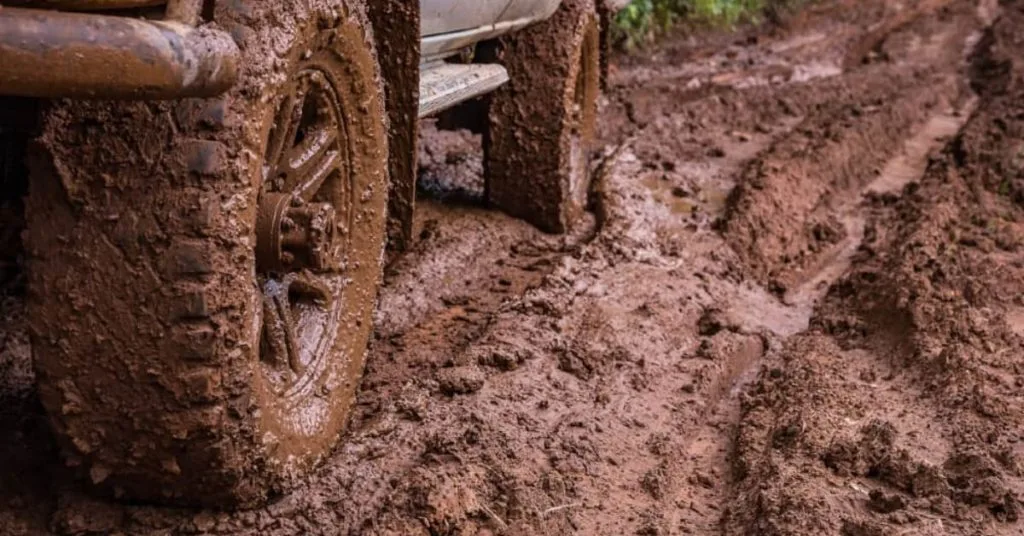
Take your foot off the gas. Whatever else you do, that comes first. A spinning tire digs its own hole, slicks the walls, and throws out the only firm ground you had. A lot of the cars that end up needing a truck got there in the first thirty seconds, when the driver felt the wheels slip and pushed harder.
This page covers what to try, in the order we’d try it, and how to tell when you’re done. If you’re already past that point, the number is (301) 540-1600.
The short version, if you’re reading this with the engine running:
- Stop spinning the wheels.
- Get out and look, if it’s safe. Check whether the car is sitting on its tires or on its body.
- Clear the mud from in front of the drive wheels.
- Rock gently between drive and reverse, stopping fully between shifts, if your manual allows it.
- Put floor mats, boards, or branches tight against the drive wheels and try again.
- If the car sinks lower, or its body is on the mud, stop and call.
That’s the whole method. The rest of this page is how to do each step without making it worse, and how to know which of those situations you’re in, and how to get in touch with us if you need a tow.
What to do first when your car is stuck in mud
Get out and walk around the car if it’s safe. Safe means the car is level and still. Not on a slope, not sliding, not beside a lane of moving traffic, not in water that’s rising. If any of those is true, stay in the car with your seatbelt on and make the call now. Nothing on this page is worth standing in a live lane for.
Two things to look at:
- Is the car still sitting on its tires? Look under the middle of the car. If the underside is clear of the mud, the car is still on its wheels and you have a good chance of driving it out. If the underside is resting on the mud, the wheels aren’t holding much weight and will spin whatever you put under them. That’s called high-centered, and it takes a winch.
- Where’s the firm ground? Mud is deeper in some directions than others. Look ahead and behind for the nearest solid ground, and head that way. Often that’s backwards, the way you came in, since the ground you just drove over was holding the car a minute ago.
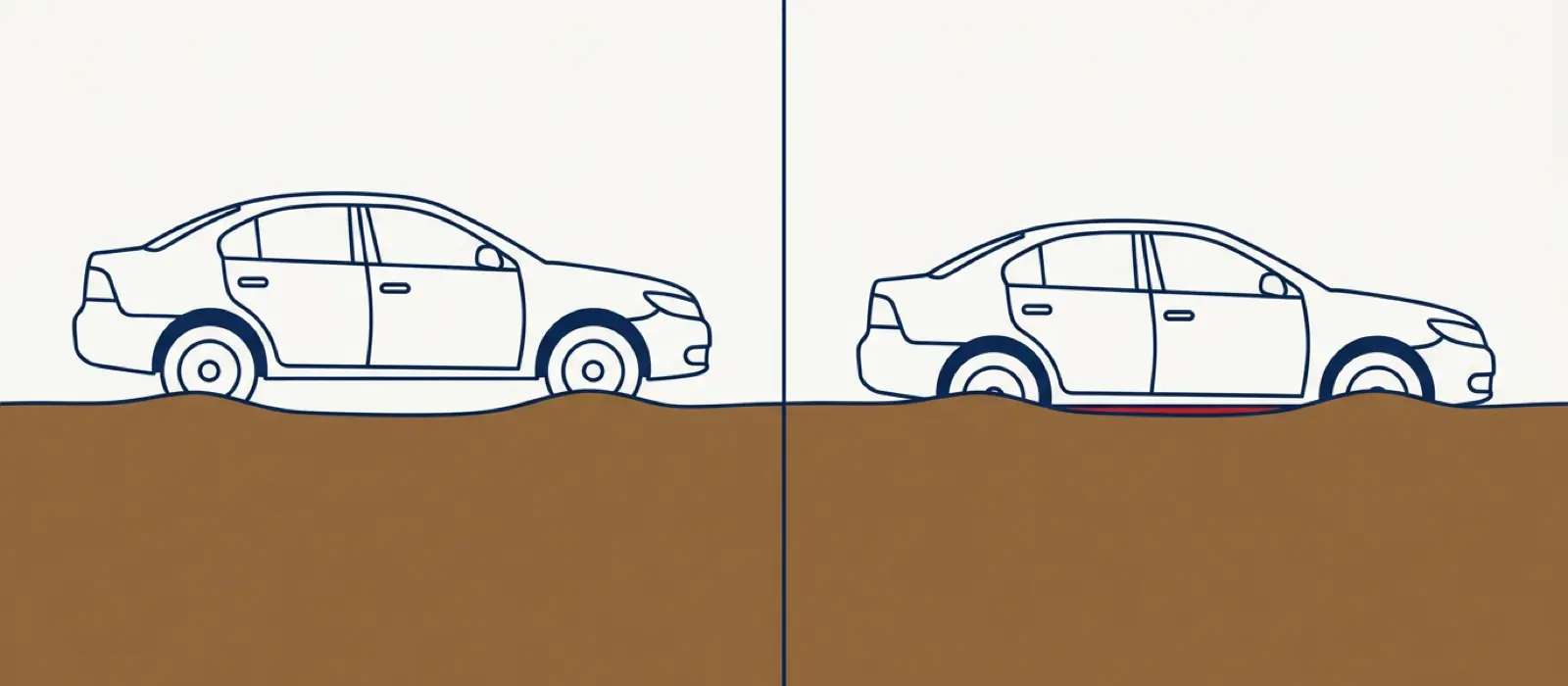
While you’re down there, look at the tires. If the grooves are packed solid with mud, the tire is as smooth as a bald one and has nothing to grip with. Scrape the mud out with a stick if you can reach it.
How to get a car out of mud on your own
Try the steps below in order. Move to the next one only if the last one didn’t work and the car hasn’t sunk any further. If it has, the ground under you isn’t going to hold. Stop there and call.
Clear the mud away from the drive wheels
Dig the mud away from in front of the drive wheels, in the direction you want to go. Use your hands, a stick, the jack handle, whatever you have. The tire is sitting in a hole with a wall in front of it. You want to turn that wall into a slope it can roll up. Pull out any rocks or roots in the way.
The drive wheels are the ones the engine turns. On most cars that’s the front two. On most pickups it’s the back two. On all-wheel drive and 4×4 it’s all four.
Rock the car out of the mud, gently
Rocking means going a little forward, then a little back, then forward again, so the tire packs the mud down ahead and behind until it can climb out. Some owner’s manuals describe it. Ford’s, for one, says to shift between forward and reverse, stopping between shifts, in a steady pattern. If your manual says not to rock the car, don’t. Done wrong, it’s hard on an automatic transmission.
Done properly it looks nothing like the movies. Put the car in its lowest gear, which is L or 1 on most automatics. Keep the steering wheel straight. Give it just enough gas to move, then ease off and come to a full stop. Then reverse, the same way. If a tire starts to spin, stop. Don’t add gas. Spinning is the one thing that turns a car you could have driven out into one you can’t.
If the car moves a little further each time, keep going. If it settles lower instead, stop. The ground under you won’t pack down. The next step is putting something under the wheels, or the phone.
Put something under the tires for grip
Put something solid in front of the tire, on the slope you dug, so it has something to grip for the first turn or two. Floor mats are the usual answer because everyone has them. Boards, gravel, sand, branches laid across the hole, flattened cardboard, or the plastic traction boards sold for exactly this. None of it is a guarantee. Cardboard might get you one turn of the wheel. Proper traction boards might get you a car length.
Tuck it tight against the front of the tire and press it in, then the same gentle gas as before. A mat that isn’t tucked in comes out from under the tire fast, so nobody stands behind the car or in line with the wheels.
How to get a truck or 4×4 unstuck from mud
A truck stuck in mud has more to work with, and more weight to move. If you have four-wheel drive, put it in low, usually marked 4L, if it isn’t already. Low gives you a slow crawl with a lot of pulling power, which is what you want here. High just makes it easier to spin all four wheels. If your truck has a rear locker, a button that locks both back wheels together, turn it on. Traction control can work against you here by cutting power the instant a wheel slips. If your truck lets you switch it off, do that for the attempt and turn it back on once you’re on solid ground.
In two-wheel drive, remember the drive wheels are at the back, under an empty bed. Put the mats or boards there, not under the front wheels. And if the bed is loaded, or you’re pulling a trailer, that weight changes the whole job. The table below covers it.
Should you let air out of the tires?
People who drive off-road on purpose let some air out of their tires before they leave the pavement. They do it with a pressure gauge, a pump to fill them back up, and tires they know. Done that way, a softer tire spreads out and puts more rubber on the ground. Done in a panic, on an ordinary tire, with no way to pump it back up, it’s a good way to pop the tire off the rim or to drive home on a tire that’s overheating. Tire makers say the right pressure depends on the tire, the vehicle’s weight, and the ground, and that you fill back up before you touch pavement. If you don’t have a gauge and a pump, skip this one.
Pulling a car out of mud with a strap
If a friend with a truck turns up, a pull can work. It’s also where people get hurt. The strap has to be a proper recovery strap, the kind sold for pulling vehicles, and it has to hook to the tow hook or loop built into the frame of each vehicle. Your manual shows where that is. Not the bumper, not the trailer ball, not any part of the suspension. If the strap snaps, or the tow ball breaks off, it flies back hard enough to go through a windshield.
Straight pull, slow and steady, no running starts, and everyone else well clear of both vehicles. If you don’t have the strap, don’t know where the tow hooks are, or the other vehicle is on soft ground too, call instead. Two stuck vehicles is a worse afternoon than one.
When to stop and call a tow truck for a car stuck in mud
The left column is what you can see from where you’re standing. The other two are what we’d tell you if you called and described it.
| What you can see | Keep trying? | What to do |
|---|---|---|
| The car is level, the tires are sunk but the underside is clear of the mud, and nothing around you is dangerous | Yes | Work through the steps above once. Stop the moment a wheel spins or the car sinks lower. |
| Every attempt leaves the car lower than before | No | The ground isn’t going to hold. Call and say the car is sinking. |
| The underside of the car is resting on the mud | No | The wheels aren’t holding the car up, so nothing you put under them will help. Call and say the car is sitting on its belly. |
| The car is on a slope, sliding, next to moving traffic, or in water | No | Stay in the car with your seatbelt on and call. Say which of those it is, so we send the right truck and park it somewhere safe. |
| The car went off the road or was in a crash before it got stuck | No | There may be damage you can’t see. Call and describe what happened. Our ditch recovery guide covers what happens next. |
| Someone offers to pull you out, but there’s no proper strap, you don’t know where the tow hooks are, or their vehicle is on soft ground too | No | Don’t improvise it. Call instead. |
| A loaded pickup, box truck, trailer, or farm equipment | No | This needs a heavy-duty truck from the start. Say what’s on board and roughly what it weighs. |
| You’re a long way from the road, through a gate, or down a soft track | Try, then call | Try the steps if it’s safe. When you call, say exactly how a truck gets to you. |
What to tell the tow company when you call
Dispatch asks a few questions before sending anything, because the wrong truck arriving at a wet field is how a simple recovery turns into a long one. Have these ready:
- Where you are. An address if there is one. If not, the road name, the last turn you made, a dropped pin, and anything a driver would recognize, like a park entrance or a farm gate.
- What you’re driving. Year, make, and model tells the dispatcher the weight, which wheels drive, and where the tow hooks are before the truck leaves.
- What happened and what you can see. Tires buried, car sitting on the frame, on a slope, in water, how far it’s sunk since you stopped.
- How a truck gets to you. How far off the pavement you are, whether the ground between is soft, any gate, any low branches.
- Anything on board. A trailer, a load in the bed, passengers who need a ride.
When the truck arrives, the operator looks before hooking anything up: where the solid ground is for the truck itself, where your tow hooks are, which way the pull needs to go. Most car and pickup mud recoveries are a winch job. The truck stays on firm ground, a cable runs to your frame, and the car comes out slowly under control. You won’t be asked to floor it.
A car sitting on its belly, a vehicle on its side, or a loaded truck needs a different truck from the start, which is why the questions matter. Dispatch picks the truck based on what you’re driving, how to get to it, and what it’s sitting in. Commercial trucks, trailers, and farm machinery are handled as heavy-duty jobs. Anything that was in a crash is handled as accident recovery.
Will AAA or insurance pull me out of the mud?
Usually, if the truck can get to you. AAA Club Alliance, the club that covers Maryland, says it will pull a car out that’s stuck in mud, snow, or a ditch as long as it’s still safely reachable. How far off a road that means is in your club’s terms, and it’s the same story with the roadside cover on your insurance or credit card. If you’re not sure, check the app before you call anyone.
If the plan won’t cover where you are, or you’d rather not wait to find out, you can call a recovery company and pay for the winch-out yourself. Winching changes the price of a tow, so describe what you’re looking at and ask. What goes into the price is on our towing cost page.
What to check after getting your car out of mud
Don’t stop in the mud to celebrate. Keep rolling until you’re on ground that holds. If you let air out of the tires, pump them back up before you drive on pavement.
Rinse the mud out of the wheel wells and off the underside as soon as you can. Packed mud holds water against metal and raises the risk of corrosion, and a lump of clay inside a wheel will shake the steering at speed. Listen for rubbing from the brakes on the first few stops. If something feels wrong, get it looked at rather than driving through it.
Stuck in mud in Maryland right now?
Geyers Towing dispatch answers 24 hours a day, every day, at (301) 540-1600. Tell us where you are, what you’re driving, and what you can see, and we’ll send the right truck.
- Towing and recovery here since 1993
- WreckMaster certified operators
- Recovery equipment rated up to 75 tons
- Montgomery County, Frederick County, and the surrounding area
We run recovery out of Germantown and Mt. Airy.
Car stuck in mud FAQs
How do you get a car out of mud without a winch?
Stop spinning the wheels. Dig the mud away from the front of the drive wheels to make a ramp, then rock the car gently between drive and reverse, stopping fully between shifts, if your owner’s manual allows it. If that doesn’t move it, put floor mats, boards, gravel, or branches tight against the front of the drive wheels and try again with light gas. Stop if the car sinks lower or its body is resting on the mud.
Will AAA pull me out of the mud?
Often, if the car can be safely reached. AAA Club Alliance, which covers Maryland, says it will pull out a vehicle stuck in mud, snow, or a ditch that is still safely reachable. Where a service truck can’t safely get to the car, coverage depends on your club and membership terms, and you may need a recovery company that will come to the vehicle wherever it is.
Can 4×4 trucks still get stuck in mud?
Yes. Four-wheel drive sends power to all four wheels, but if all four are sitting in mud that won’t hold, all four spin. A 4×4 also sinks just as readily once it’s high-centered on its frame. Four-wheel low and a rear locker help you get out, but they don’t stop you going in.
What should you not do when stuck in mud?
Don’t keep spinning the wheels. Don’t rock the car hard or fast, which cooks the transmission. Don’t attach a strap to a bumper, tow ball, or suspension part. Don’t let anyone stand behind the car or in line with a strap during a pull. And don’t get out to try things if the car is on a slope, sliding, next to traffic, or in water.
Who do you call when your car gets stuck in the mud?
If you have a roadside plan through AAA, your insurer, or a credit card, check whether it covers winching where you are. Otherwise, or if you’d rather not wait to find out, call a local towing and recovery company directly. In Montgomery County, Frederick County, and the surrounding area, Geyers dispatch answers 24 hours a day at (301) 540-1600.
Can getting stuck in mud damage your car?
It can, and most of the damage comes from the getting out rather than the mud. Long wheel spin overheats tires and the transmission. Hard rocking is rough on the transmission and axles. A pull from the wrong attachment point bends bumpers and mounts. Mud packed in the wheel wells and underbody holds moisture against metal. Rinse it off soon after, and have anything that feels different checked.