
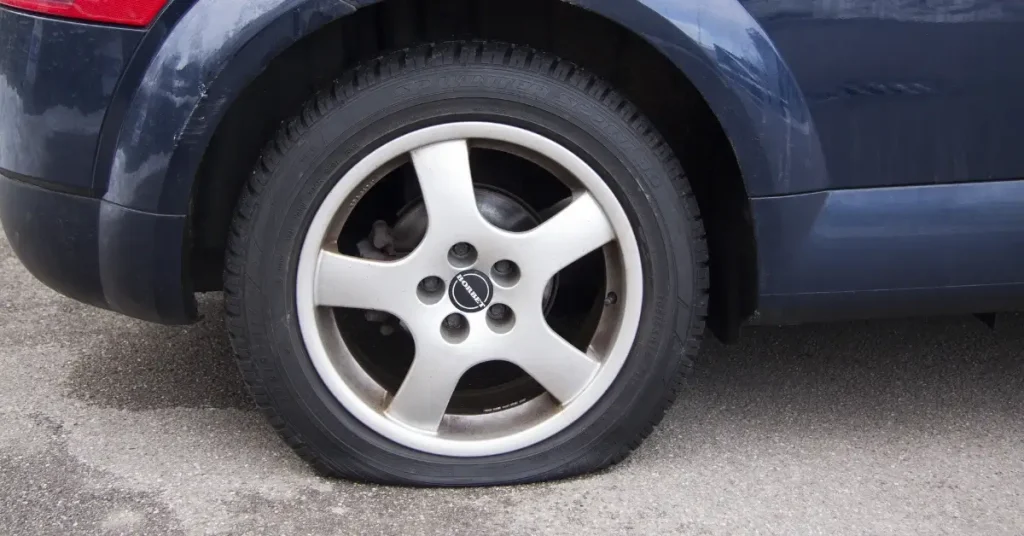
Technically, yes. The vehicle will move. Whether you should is a different question entirely, and the answer is no – not a block, not a mile, not to the next exit. Every foot of movement on a flat tire converts a manageable repair into a compounding damage situation that starts at rim destruction and can work its way up through wheel bearings and suspension.
The reason people ask this question is almost always the same: they are already on the side of the road, trying to figure out whether calling for help is really necessary or whether they can get themselves somewhere under their own power. This guide answers that question directly – what actually happens inside the tire and under the vehicle when you drive on a flat, what it costs when you do, and what your real options are when the alternative to driving does not feel obvious.
Geyers Towing responds to flat tire calls throughout Montgomery and Frederick Counties, Northern Virginia, and the greater Maryland and DC corridor – 24/7, with a 15-minute response. The difference between the repair bills we see on vehicles that stayed put versus vehicles that moved – even briefly – is consistent enough to be worth putting on paper.
If you are reading this from the side of the road, that difference is still yours to control.
Can You Drive on a Flat Tire Without Damaging the Rim?
No. This is the specific version of the question most drivers are actually asking, and the answer is unambiguous. Rim damage from flat tire driving begins not when the tire is fully destroyed, but when the sidewall compresses far enough to bring the rim’s lower edge into contact with the road surface. On most passenger vehicles, that contact happens within a short distance of initial movement – sometimes within the first rotation.
A standard tire rim sits roughly 10 to 13 inches from the ground on an inflated tire. When tire pressure reaches zero, the sidewall collapses and that clearance disappears. At the point of contact, the rim – typically cast aluminum alloy on modern vehicles, steel on older ones – begins scraping against pavement. Alloy rims crack. Steel rims bend. Neither damage type is reversible without replacement.
Rim replacement costs run $200 to $500 per wheel for standard alloy rims. Performance or specialty rims run higher. That cost is entirely avoidable if the vehicle does not move after the flat is detected.
What Actually Happens to a Tire When You Drive on It Flat
The physical sequence that unfolds when a flat tire moves is worth understanding in detail – because most of the damage is invisible until a mechanic puts the vehicle on a lift. You cannot judge the extent of it from the outside.
Stage One: Sidewall Failure
A tire’s sidewall is engineered for flex under load, but that flex operates within a narrow range defined by internal air pressure. At zero PSI, the sidewall folds completely under the vehicle’s weight with each rotation. Each fold cycle fractures the internal cords – the reinforcing fibers woven into the rubber carcass that give the tire its structural shape. After enough cycles, those cords separate. The tire cannot be repaired. It can only be replaced.
The fracture damage to internal cords is not visible from the outside. A flat tire that has been driven on may look like it has some rubber remaining, but the structural integrity is gone. Reinflating it would be pointless and dangerous.
Stage Two: Heat Accumulation
Rubber flexing against pavement generates heat at a rate that surprises most people. A tire at operating pressure dissipates heat through the air column inside. A flat tire has no air column – the heat stays in the rubber. At low speeds, this heat buildup accelerates rubber degradation. At higher speeds, it creates conditions for a catastrophic blowout: the tire does not simply stay flat, it comes apart in sections.
Heat-related blowouts on flat tires happen faster than most drivers expect. A flat tire driven at highway speed can reach blowout conditions within under a mile. At low residential speeds the timeline is longer, but the outcome is the same – total tire destruction before most drivers reach their intended stopping point.
Stage Three: Rim Contact and Pavement Damage
Once the sidewall is fully compressed, the rim contacts the road surface with the vehicle’s weight bearing down on it. The scraping that follows is not cosmetic. Each rotation grinds material from the rim edge. Aluminum alloy develops cracks that propagate inward from the contact point. Steel develops flat spots and bends. Either failure mode means the rim cannot safely seat a new tire without replacement.
Pavement contact also generates sparks. On a dry road, this is alarming but not immediately dangerous. Near spilled fuel at an accident scene, it is a different situation entirely – which is one reason first responders strongly prefer that vehicles involved in collisions not be moved by their drivers.
Stage Four: Secondary Component Stress
The damage does not stop at the rim. A vehicle moving on a flat tire distributes load unevenly across the wheel assembly. The wheel bearing absorbs lateral stress it was not designed to handle. The tie rod and control arm experience abnormal force vectors. Suspension components that are already stressed by the collapsed tire geometry take impacts differently than they would on an inflated tire.
Wheel bearing replacement runs $150 to $400 per bearing depending on vehicle type. Tie rod and control arm work starts at $200 and climbs quickly for vehicles with complex front suspension designs. These repairs stack on top of the rim and tire replacement, not instead of them.
What Driving on a Flat Tire Actually Costs
| Decision | Damage Likely | Repair Cost Range |
|---|---|---|
| Stop immediately | Tire replacement only | $150 – $300 |
| Drive a short distance | Tire + rim replacement | $350 – $800 |
| Drive to a shop | Tire + rim + wheel bearing / suspension | $700 – $1,500+ |
The One Exception: Run-Flat Tires
Run-flat tires are the only situation in which driving on a flat tire is manufacturer-sanctioned – and even then, within strict limits. Run-flats are designed with reinforced sidewalls that support vehicle weight at zero PSI, typically allowing 50 miles of driving at speeds under 50 mph before the tire must be replaced.
Two conditions must both be true before the run-flat exception applies. First, your vehicle must have been factory-equipped with run-flat tires – they are standard on certain BMW, Mini, and Cadillac models, and optional on others, but they are not interchangeable with standard tires. Second, your tire pressure monitoring system must be functioning and confirming which tire has failed. Driving on a run-flat beyond its rated distance destroys it the same way driving on a standard flat tire does, just slower.
If you are not certain whether your vehicle has run-flat tires, assume it does not. The identifying markings (typically “RFT,” “ROF,” “SSR,” or “EMT” on the tire sidewall) are small and not visible from the driver’s seat. When in doubt, the conservative call is the right one.
What to Do When You Have a Flat Tire Instead of Driving
The alternative to driving on a flat tire is not simply “wait and hope.” There are three practical options, and knowing which applies to your situation makes the decision immediate rather than agonizing.
Option One: Spare Tire Swap
If your vehicle carries a usable spare and you are in a location safe enough to change it, a spare tire swap is the fastest path forward. Confirm the spare is inflated before you start – a flat spare is not uncommon on vehicles where the spare has never been checked. Compact spares (the narrow “donut” spare found in most passenger vehicles) are rated for temporary use at speeds under 50 mph and distances under 70 miles. They get you to a tire shop, not across the state.
The location question matters more than most drivers weigh it. Changing a tire on a highway shoulder, on a steep incline, in active traffic lanes, or in low-visibility conditions carries genuine risk. If the location is not safe for a DIY tire change, it is not safe – and roadside assistance is the call regardless of whether a spare is available.
Option Two: Roadside Tire Change Service
This is the option most people do not think of as a distinct choice from a full tow. Geyers Towing provides roadside tire change service – we come to your location and mount your spare for you. You do not have to change a tire yourself on a dark shoulder, an unsafe grade, or during heavy traffic. If your spare is usable, we handle the swap on-scene. If it is not – flat, degraded, or missing – we tell you immediately and move to the tow option without a second call or a second wait.
Calling for a roadside tire assessment is free. You find out on the phone what your situation actually is before any decision gets made.
Option Three: Flat Tire Tow to a Shop
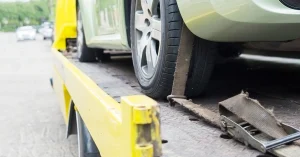
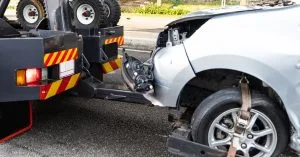
When there is no usable spare, when the rim is already damaged from pavement contact, when the flat happened at highway speed and secondary damage is possible, or when the cause of the flat is not obviously a simple puncture – a tow is the right call. Your vehicle goes onto the flatbed without any additional movement on the damaged wheel. It arrives at the shop in exactly the condition it was in when it stopped, not worse.
For drivers on I-270, Route 70, or Route 27 near the Montgomery and Frederick County corridors, a flat tire tow from Geyers Towing means a 15-minute response and a clean transport to the shop of your choice – not a designated vendor, not a shop we have a relationship with. Your vehicle, your shop.
$500
Maximum rim replacement cost from driving on a flat
50 mi
Maximum rated distance for run-flat tires at zero PSI
15 min
Geyers Towing response time across Montgomery and Frederick Counties
How to Read a Flat Tire Situation Correctly Before You Decide Anything
Most of the bad decisions around driving on a flat tire come from misreading the situation in the first sixty seconds. Here is how to read it accurately.
- First: is the tire actually flat, or is it losing pressure? A tire that feels soft but is not fully deflated may have enough pressure remaining for a slow, careful movement to a safe location – not a shop, not an exit, but a safer spot on the same road. Tire pressure monitoring systems that trigger at 25% pressure loss still have air in the tire. A tire that has fully deflated does not.
- Second: has the rim already contacted the road? If you heard a metallic scraping sound, felt the vehicle drop on one corner with a grinding sensation, or can see damage to the rim when you get out, the rim has already made contact. In that case, additional movement does not add to the damage in a way that changes the repair outcome – the rim is already compromised and needs replacement regardless. The priority at that point is stopping in the safest possible location and calling for a tow.
- Third: what caused the flat? A nail in the center tread is a clean, repairable situation – plug and patch, roughly $25 to $35 at most shops. A sidewall puncture, a blowout, or a flat with no visible cause all warrant professional inspection before any tire is reinstalled. A tire that failed for an unknown reason on one corner may indicate a brake or bearing issue generating heat, a wheel misalignment causing abnormal wear, or a manufacturing defect. Those underlying causes do not get diagnosed at the roadside.
The Right Sequence When a Flat Happens
Sequence matters more than speed in a flat tire situation. Here is the right order of operations:
- Ease off the accelerator – do not brake hard. A flat at speed destabilizes the vehicle. Gradual deceleration maintains steering control; hard braking can cause a skid on the deflated corner.
- Move fully off the travel lane. A partial shoulder stop is more dangerous than driving an additional hundred feet to a full shoulder or parking area. Get the vehicle completely clear of traffic.
- Activate hazard lights immediately. Before you assess anything, before you get out, before you make any call – hazards on.
- Assess the location from inside the vehicle. Is there a safe shoulder width? Is visibility adequate? Is traffic passing at highway speed six feet away? If any safety factor is uncertain, stay in the vehicle with your seatbelt fastened and call from inside.
- Call for a free roadside assessment. Describe your vehicle, your location, and what happened. From that information, a dispatcher can tell you whether a roadside tire swap or a flat tire tow makes more sense for your specific situation – before you commit to either.
Can You Drive on a Flat Tire? Here Is the Final Answer
You can, in the same sense that you can do a lot of things that cost significantly more money than the alternative. A flat tire that stays still costs $150 to $300 to fix. A flat tire that moves costs $350 to $1,500 depending on what breaks in addition to the tire itself. The rim, the wheel bearing, the suspension – none of those costs were there before the vehicle moved.
Calling Geyers Towing for a flat tire in Montgomery or Frederick County means a 15-minute response, a free assessment of whether your spare handles the situation or a tow does, and a clear answer before any money changes hands. That call takes two minutes. The alternative – driving on the flat and finding out what it damaged when the vehicle gets on a lift – takes considerably longer and costs considerably more.
Frequently Asked Questions
Can you drive on a flat tire to the nearest gas station?
No. Even a short distance on a flat tire destroys the sidewall and risks $200 to $500 in rim damage. If a gas station is visible from where you stopped, call for roadside assistance instead of driving to it. The cost of the call is far less than the rim and suspension damage that even a brief drive on a flat can cause.
How far can you drive on a flat tire before it causes damage?
For a standard tire, damage to the sidewall begins within the first rotation. There is no safe distance to drive on a flat standard tire. Run-flat tires are the only exception, rated for up to 50 miles at speeds under 50 mph on vehicles factory-equipped with them.
Can you drive on a flat tire at low speed?
Low speed reduces heat buildup slightly but does not prevent sidewall destruction or rim contact with the pavement. The damage from driving on a flat at 5 mph accumulates more slowly than at highway speed – but the outcome is the same. Rim damage and internal cord failure occur regardless of how slowly the vehicle moves.
What does driving on a flat tire sound like?
A flat tire in motion produces a rhythmic thumping or flapping sound from the deflated rubber contacting the road. Once the rim contacts the pavement, the sound shifts to a grinding or scraping noise. If you hear grinding, the rim is already being damaged and the vehicle should stop immediately at the nearest safe location.
Can a tire that was driven on flat be repaired?
In almost all cases, no. Driving on a flat tire destroys the internal cord structure of the sidewall. Even if the tire holds air after reinflation, the structural integrity is compromised and the tire is not safe to use. A tire driven on flat must be replaced, not repaired.
Does insurance cover damage from driving on a flat tire?
Standard auto insurance policies typically do not cover mechanical damage caused by driving on a flat tire, as it falls under driver negligence rather than a covered incident. Roadside assistance coverage – either through your insurer or a separate membership – may cover the tow or tire swap itself, but not the secondary damage to the rim or suspension that results from continuing to drive.
What should I do if I get a flat tire on I-270?
Ease off the accelerator, activate hazards, and move as far right as the road allows. If you can reach a full shoulder or emergency pull-off, do so without driving further on the flat than necessary. Stay in the vehicle if the shoulder is narrow or traffic is close. Call Geyers Towing – we serve the full I-270 corridor in Montgomery County with fast response and 24/7 dispatch.